

Christian Metal Wall Art
Crosses, the Last Supper, the Sacred Heart, praying hands, the Nativity, Christ the Redeemer — this is the largest collection in the studio, and the one we cut most often. Each piece of Christian metal wall art here is a single silhouette in steel: no print, no frame, just the shape and the shadow it throws on your wall.
What is in this collection
Twenty-five designs, grouped by what people actually come looking for.
Crosses. The plain Christian cross and the heavier rustic cross are the two we cut most. The three crosses read as Calvary and are the piece most often ordered at 90 cm and above. The angel wings cross and the butterfly cross are gentler, and are usually chosen for a child’s room or as a memorial piece. The cross on a landscape sets the cross against a horizon and works as a wide piece over a sofa or a sideboard.
Scenes. The Last Supper is the widest piece we make and the one that holds a dining wall on its own; there is also a line-drawn interpretation for people who want the reference without the full tableau. The Nativity comes out every Advent and goes back in the box in January. The washing of the feet and the shepherd with his sheep are the quieter narrative pieces.
Figures. Christ the Redeemer, the Sacred Heart, the Virgin Mary, the face of Christ, Jesus reading, Jesus carrying the cross and the sacred angel.
Words. Praying hands with a cross, a scripture line, Man of God, and This Is Not The End — the piece most often bought after a loss.
Choosing a piece for a home or a church
For a living room or entryway, one large cross or a Sacred Heart at 60–80 cm reads clearly from across the room. Prayer rooms and bedside walls suit the quieter line-art pieces — Jesus Reading, the Foot Washing, Praying Hands — at 40–50 cm. For a church hall, fellowship room or outdoor prayer garden, the 90 and 100 cm sizes hold a wall on their own; the Three Crosses and the Last Supper are the two we cut largest.
The rule that saves most people a return: measure the furniture, not the wall. A piece should span roughly two thirds of whatever sits beneath it. Over a three-seat sofa that is 80–100 cm. Over a console or a bed head it is 60–80 cm. On an empty stair wall, where there is nothing to measure against, go one size up from what feels right — steel silhouettes read smaller than solid panels because the wall shows through them. Our size guide has the numbers for every size we cut.
Which finish
Black is the most chosen for faith pieces — it reads as ironwork and sits well on plaster, brick and wood. Gold suits sanctuary walls and warm interiors; bronze is the traditional choice for a cross and is the finish that photographs closest to aged metal. White works on dark or coloured walls where a black silhouette would disappear. Silver is the coolest of the five and belongs with grey, concrete and modern joinery.
All five are powder coats, not paints, so the colour is baked on rather than brushed on. The finish guide shows each one photographed on the same design, in the same light, so you can compare them honestly.
Indoor and outdoor
Every piece in this collection is cut and coated the same way, and the powder coat is the same one used on garden furniture. A cross on a covered porch, a prayer-garden wall or a church exterior will hold its finish. Two things matter outdoors: leave the piece proud of the wall so water cannot sit behind it — the hardware we send does this — and rinse the salt off two or three times a year if you are near the coast. Materials and care covers the rest.
Gifts
A cross or a scripture piece is the usual choice for a baptism, a confirmation, a wedding or a new home. For a christening, the smaller sizes at 20–30 cm are the ones that get hung; anything larger tends to wait for a house move. For a wedding, the Sacred Heart and the cross-on-a-landscape are the two most often chosen as a joint gift. For a bereavement, This Is Not The End and the butterfly cross are what people ask for, and we will hold shipping to a date if you tell us when you need it.
Every order ships in a rigid box with the hanging hardware and a paper template, so the recipient can hang it the day it arrives. If you want a name or a date added to a cross, ask us through the contact page.
How these are made
Every design in this collection is drawn in the studio, cut from sheet steel on our own laser, deburred by hand, and powder-coated to the finish you choose. Nothing is stamped out in advance: the cut starts after the order, which is why there are nine sizes and five finishes rather than whatever happens to be in a warehouse. Making takes 3–5 business days, transit is 5–7, and shipping is free worldwide with duties included to the US, the EU and the UK — the price you see is the price at your door.
Hanging
Pieces up to 50 cm hang on the hardware in the box on almost any wall. Above that, on plasterboard, use the template to find a stud for at least one fixing point; on brick or plaster, the supplied plugs are enough. Larger pieces have multiple hanging points and want a second pair of hands rather than a bigger screw. How to hang metal wall art walks through each wall type.
Showing 1–12 of 25 results
-

Angel Wings Cross — Metal Wall Art
from $100Select options This product has multiple variants. The options may be chosen on the product page -

Butterfly Cross — Metal Wall Art
from $102Select options This product has multiple variants. The options may be chosen on the product page -

Christ the Redeemer — Metal Wall Art
from $97Select options This product has multiple variants. The options may be chosen on the product page -
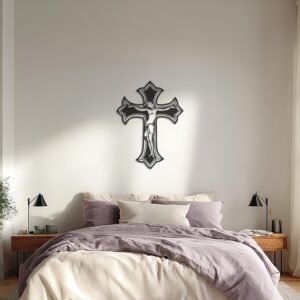
Christian Cross — Metal Wall Art
from $101Select options This product has multiple variants. The options may be chosen on the product page -

Christian Cross Landscape — Metal Wall Art
from $97Select options This product has multiple variants. The options may be chosen on the product page -
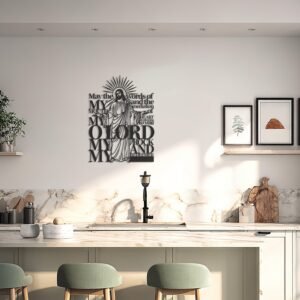
Christian Scripture — Metal Wall Art
from $101Select options This product has multiple variants. The options may be chosen on the product page -

Cross — Metal Wall Art
from $97Select options This product has multiple variants. The options may be chosen on the product page -

Jesus and Phoenix — Metal Wall Art
from $98Select options This product has multiple variants. The options may be chosen on the product page -

Jesus Cross — Metal Wall Art
from $102Select options This product has multiple variants. The options may be chosen on the product page -

Jesus Face — Metal Wall Art
from $101Select options This product has multiple variants. The options may be chosen on the product page -

Jesus Foot Washing — Metal Wall Art
from $110Select options This product has multiple variants. The options may be chosen on the product page -
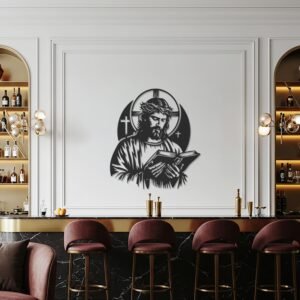
Jesus Reading — Metal Wall Art
from $98Select options This product has multiple variants. The options may be chosen on the product page
Crosses, the Last Supper, the Sacred Heart, praying hands, the Nativity, Christ the Redeemer — this is the largest collection in the studio, and the one we cut most often. Each piece of Christian metal wall art here is a single silhouette in steel: no print, no frame, just the shape and the shadow it throws on your wall.
What is in this collection
Twenty-five designs, grouped by what people actually come looking for.
Crosses. The plain Christian cross and the heavier rustic cross are the two we cut most. The three crosses read as Calvary and are the piece most often ordered at 90 cm and above. The angel wings cross and the butterfly cross are gentler, and are usually chosen for a child’s room or as a memorial piece. The cross on a landscape sets the cross against a horizon and works as a wide piece over a sofa or a sideboard.
Scenes. The Last Supper is the widest piece we make and the one that holds a dining wall on its own; there is also a line-drawn interpretation for people who want the reference without the full tableau. The Nativity comes out every Advent and goes back in the box in January. The washing of the feet and the shepherd with his sheep are the quieter narrative pieces.
Figures. Christ the Redeemer, the Sacred Heart, the Virgin Mary, the face of Christ, Jesus reading, Jesus carrying the cross and the sacred angel.
Words. Praying hands with a cross, a scripture line, Man of God, and This Is Not The End — the piece most often bought after a loss.
Choosing a piece for a home or a church
For a living room or entryway, one large cross or a Sacred Heart at 60–80 cm reads clearly from across the room. Prayer rooms and bedside walls suit the quieter line-art pieces — Jesus Reading, the Foot Washing, Praying Hands — at 40–50 cm. For a church hall, fellowship room or outdoor prayer garden, the 90 and 100 cm sizes hold a wall on their own; the Three Crosses and the Last Supper are the two we cut largest.
The rule that saves most people a return: measure the furniture, not the wall. A piece should span roughly two thirds of whatever sits beneath it. Over a three-seat sofa that is 80–100 cm. Over a console or a bed head it is 60–80 cm. On an empty stair wall, where there is nothing to measure against, go one size up from what feels right — steel silhouettes read smaller than solid panels because the wall shows through them. Our size guide has the numbers for every size we cut.
Which finish
Black is the most chosen for faith pieces — it reads as ironwork and sits well on plaster, brick and wood. Gold suits sanctuary walls and warm interiors; bronze is the traditional choice for a cross and is the finish that photographs closest to aged metal. White works on dark or coloured walls where a black silhouette would disappear. Silver is the coolest of the five and belongs with grey, concrete and modern joinery.
All five are powder coats, not paints, so the colour is baked on rather than brushed on. The finish guide shows each one photographed on the same design, in the same light, so you can compare them honestly.
Indoor and outdoor
Every piece in this collection is cut and coated the same way, and the powder coat is the same one used on garden furniture. A cross on a covered porch, a prayer-garden wall or a church exterior will hold its finish. Two things matter outdoors: leave the piece proud of the wall so water cannot sit behind it — the hardware we send does this — and rinse the salt off two or three times a year if you are near the coast. Materials and care covers the rest.
Gifts
A cross or a scripture piece is the usual choice for a baptism, a confirmation, a wedding or a new home. For a christening, the smaller sizes at 20–30 cm are the ones that get hung; anything larger tends to wait for a house move. For a wedding, the Sacred Heart and the cross-on-a-landscape are the two most often chosen as a joint gift. For a bereavement, This Is Not The End and the butterfly cross are what people ask for, and we will hold shipping to a date if you tell us when you need it.
Every order ships in a rigid box with the hanging hardware and a paper template, so the recipient can hang it the day it arrives. If you want a name or a date added to a cross, ask us through the contact page.
How these are made
Every design in this collection is drawn in the studio, cut from sheet steel on our own laser, deburred by hand, and powder-coated to the finish you choose. Nothing is stamped out in advance: the cut starts after the order, which is why there are nine sizes and five finishes rather than whatever happens to be in a warehouse. Making takes 3–5 business days, transit is 5–7, and shipping is free worldwide with duties included to the US, the EU and the UK — the price you see is the price at your door.
Hanging
Pieces up to 50 cm hang on the hardware in the box on almost any wall. Above that, on plasterboard, use the template to find a stud for at least one fixing point; on brick or plaster, the supplied plugs are enough. Larger pieces have multiple hanging points and want a second pair of hands rather than a bigger screw. How to hang metal wall art walks through each wall type.

Laser-cut steel wall art, made to order in our own studio and shipped worldwide with duties included.
Shop



 SSL-encrypted · Stripe